
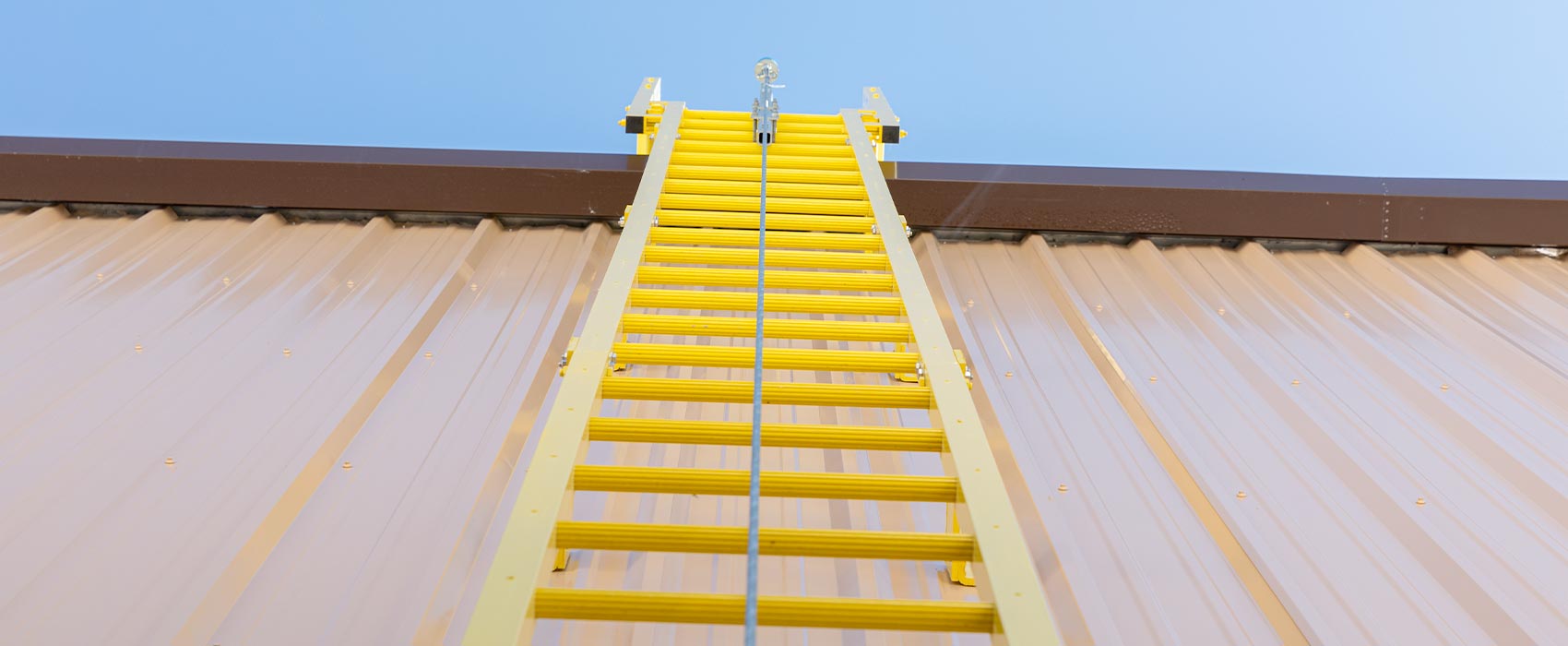
National Ladder Safety Month: Is Your Facility’s Vertical Access Built for Real Work?
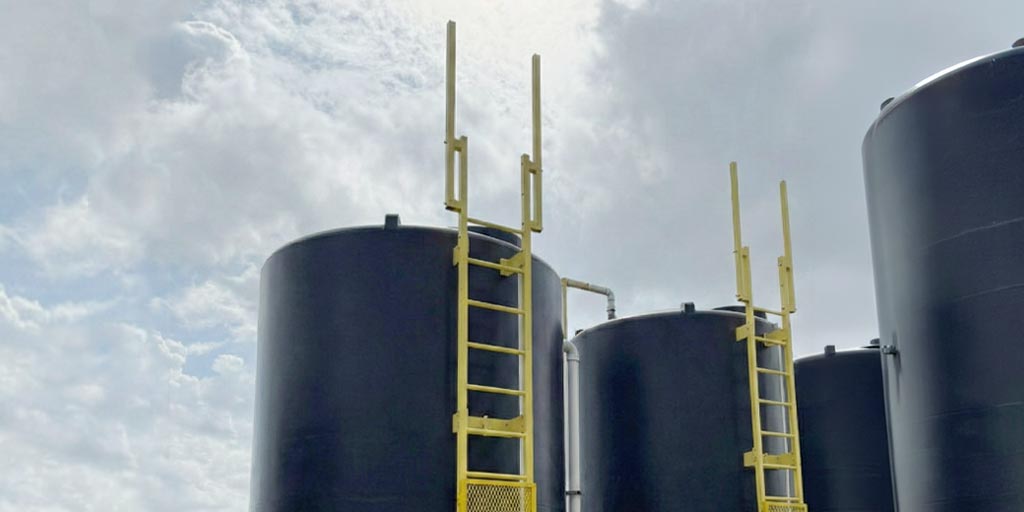
March is National Ladder Safety Month — a timely reminder that ladder safety isn’t just about compliance. It’s about whether your access systems are truly built for the way your facility operates every day — safely, consistently and without interruption.
In industrial environments, ladders aren’t occasional tools. They’re part of the workflow — used to access rooftops, tanks, boiler rooms, warehouses, distribution centers and utility areas. And when elevated work is routine, stability, durability and predictability matter.
The question isn’t: Do you have ladders? It’s: Are they engineered for repeated, reliable use?
The Hidden Risk in “Good Enough” Ladder Systems
Ladders are one of the most common — and most overlooked — risk points in industrial facilities. OSHA continues to rank ladder-related issues among its most cited violations, and many of those issues stem from systems that were never designed for long-term, high-frequency use.
Too often, facilities rely on:
- Temporary or mobile solutions where permanent access is needed
- Outdated systems lacking modern fall protection
- Incomplete ladder setups missing critical safety accessories
Over time, these “good enough” solutions create real exposure — for both workers and operations. And those risks often go unnoticed — until something goes wrong.
5 Signs Your Facility Has a Ladder Safety Problem
If you manage safety, maintenance or operations, these are the red flags to watch for:
- Long ladder runs without proper fall protection Extended climbs without rest platforms or safety systems increase fatigue and risk — and may fall out of compliance.
- No ladder security or lockout system Unrestricted access can lead to unauthorized use, vandalism or unsafe conditions.
- Limited edge protection or poor transitions Missing safety gates, walk-throughs or lead-in systems can create dangerous entry and exit points.
- Missing or improper safety accessories Ladders without the right components — gates, cages (where applicable), fall arrest systems — are incomplete systems.
- Overreliance on mobile access equipment If your team regularly uses rolling ladders or lifts for the same task, it may be time for a fixed solution.
Bottom line: Ladders are only as safe as the system around them. Properly designed, compliant ladder systems reduce risk and improve efficiency. Regular inspection and proper system design go hand in hand — one without the other leaves gaps in safety.
OSHA Updates: What You Need to Know
There’s a common misconception that ladder cages are being eliminated entirely. That’s not the case.
However, OSHA regulations are evolving — and the key change is this:
- By November 18, 2036, fixed ladders over 24 feet must include a personal fall arrest system (PFAS) or ladder safety system.
- Cages alone will not be sufficient for compliance.
- Existing cages can remain — but only if they don’t interfere with a compliant fall protection system.
For facilities planning upgrades or new installations, this is an opportunity to get ahead of the curve — not scramble to catch up later.
Quick Reference: OSHA Fixed Ladder Requirements
For a more detailed breakdown of OSHA fixed-ladder requirements, reference the chart below. The exact subpart for fixed ladders is OSHA 1910.23(d) – Fixed Ladders, which outlines what employers must ensure for compliance.
OSHA Fixed Ladder Requirements — 1910.23(d)
| OSHA Number | Definition |
|---|---|
| 1910.23(d) | Fixed ladders. The employer must ensure: |
| 1910.23(d)(1) | Fixed ladders are capable of supporting their maximum intended load; |
| 1910.23(d)(2) | The minimum perpendicular distance from the centerline of the steps or rungs, or grab bars, or both, to the nearest permanent object in back of the ladder is 7″, except for elevator pit ladders, which have a minimum perpendicular distance of 4.5″; |
| 1910.23(d)(3) | Grab bars do not protrude on the climbing side beyond the rungs of the ladder that they serve; |
| 1910.23(d)(4) | The side rails of through or side-step ladders extend at least 42″ above the top of the access level or landing platform served by the ladder. For parapet ladders, the access level is: |
| 1910.23(d)(4)(i) | The roof, if the parapet is cut to permit passage through the parapet; or |
| 1910.23(d)(4)(ii) | The top of the parapet, if the parapet is continuous; |
| 1910.23(d)(5) | For through ladders, the steps or rungs are omitted from the extensions, and the side rails are flared to provide not less than 24″ and not more than 30″ of clearance. When a ladder safety system is provided, the maximum clearance between side rails of the extension must not exceed 36″; |
| 1910.23(d)(6) | For side-step ladders, the side rails, rungs, and steps must be continuous in the extension; |
| 1910.23(d)(7) | Grab bars extend 42″ above the access level or landing platforms served by the ladder; |
| 1910.23(d)(8) | The minimum size (cross-section) of grab bars is the same size as the rungs of the ladder. |
| 1910.23(d)(9) | When a fixed ladder terminates at a hatch, the hatch cover: |
| 1910.23(d)(9)(i) | Opens with sufficient clearance to provide easy access to or from the ladder; and |
| 1910.23(d)(9)(ii) | Opens at least 70 degrees from horizontal if the hatch is counterbalanced; |
| 1910.23(d)(10) | Individual-rung ladders are constructed to prevent the employee’s feet from sliding off the ends of the rungs; |
| 1910.23(d)(11) | Fixed ladders having a pitch greater than 90 degrees from the horizontal are not used; |
| 1910.23(d)(12) | The step-across distance from the centerline of the rungs or steps is: |
| 1910.23(d)(12)(i) | For through ladders, not less than 7″ and not more than 12″ to the nearest edge of the structure, building, or equipment accessed from the ladders; |
| 1910.23(d)(12)(ii) | For side-step ladders, not less than 15″ and not more than 20″ to the access points of the platform edge; |
| 1910.23(d)(13) | Fixed ladders that do not have cages or wells have: |
| 1910.23(d)(13)(i) | A clear width of at least 15″ on each side of the ladder centerline to the nearest permanent object; and |
| 1910.23(d)(13)(ii) | A minimum perpendicular distance of 30″ from the centerline of the steps or rungs to the nearest object on the climbing side. When unavoidable obstructions are encountered, the minimum clearance at the obstruction may be reduced to 24″, provided deflector plates are installed. |
Please note that according to section 1910.28, it is the employer’s responsibility to ensure the provision of fall protection for employees on fixed ladders. Additionally, section 1910.29 outlines the criteria for fall protection systems specifically designed for fixed ladders.
Quick Reference: Additional OSHA Ladder Codes
Additional OSHA standards also apply to ladder systems, particularly around fall protection and system design.
Other Important OSHA Ladder Codes
| OSHA Number | Definition |
|---|---|
| 1910.23(b)(4) | Fixed ladder rungs/steps have a minimum clear width of 16″ |
| 1910.28(b)(9)(i) | For fixed ladders that extend more than 24′ above a lower level, the employer must ensure: |
| 1910.28(b)(9)(i)(A) | Existing fixed ladders. Each fixed ladder installed before November 19, 2018, is equipped with a personal fall arrest system, ladder safety system, cage or well; |
| 1910.28(b)(9)(i)(B) | New fixed ladders. Each fixed ladder installed on and after November 19, 2018, is equipped with a personal fall arrest system or a ladder safety system; |
| 1910.28(b)(9)(i)(C) | Replacement. When a fixed ladder, cage or well, or any portion of a section thereof, is replaced, a personal fall arrest system or ladder safety system is installed in at least that section of the fixed ladder, cage or well where the replacement is located; and |
| 1910.28(b)(9)(i)(D) | Final deadline. On and after November 18, 2036, all fixed ladders are equipped with a personal fall arrest system or a ladder safety system. |
| 1917.118(e)(1) | Fixed ladders more than 20′ in height must have a cage, well or ladder safety device. |
Why Fixed Ladders Make Sense for Industrial Access
When access is frequent and predictable, fixed ladders provide a safer, more efficient solution than temporary or mobile alternatives.
They are designed to:
- Deliver stable, permanent access to elevated areas
- Reduce setup time and variability
- Integrate with fall protection and access systems
- Minimize footprint in tight or constrained spaces
From rooftops and tanks to manholes and mechanical rooms, fixed ladders are built for environments where reliability matters. In addition, fixed ladders become even more effective when integrated with platforms, walkways and fall protection systems as part of a complete access solution.
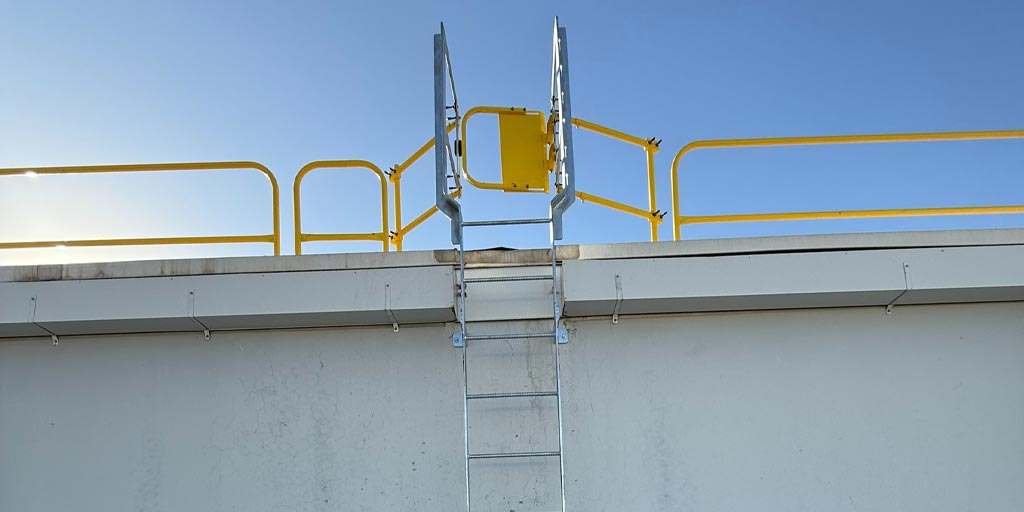
OSCO Safety Fixed Ladders: Built for Real-World Conditions
OSCO Safety’s fixed ladder systems are engineered for industrial and utility applications where space is limited — and performance is critical.
- Reliable Access Where Space Is Limited With base-mount and wall-mount options, OSCO ladders integrate seamlessly into existing structures like rooftops, tanks and confined access points.
- Built to Fit Your Operation
- Composite, aluminum and steel construction options
- Modular and custom configurations
- Accessories to support safety, compliance and usability
- NSF 61 certified options for applicable environments
- Designed for Long-Term Performance
- Corrosion-resistant materials for harsh conditions
- UV protection for outdoor exposure
- Versatile height options to match site requirements
- Quick shipping to keep projects moving
When Composite Makes a Difference
In certain environments, material choice isn’t just about durability — it’s about usability.
In high-heat areas like boiler rooms or rooftop mechanical zones, traditional metal ladders can become dangerously hot to the touch. Composite ladders made from fiberglass-reinforced polymer (FRP) offer a significant advantage, maintaining a more stable surface temperature while still delivering strength and corrosion resistance.
It’s a practical example of how the right material can directly improve safety and user experience.
ReadySeries® Fixed Ladders: Simplifying Safety
For facilities looking to streamline installation and standardize access, OSCO’s ReadySeries FRP ladder systems provide a pre-engineered solution.
These systems are designed for:
- Faster layout and installation
- Repeatable, consistent access design
- Long-term durability in demanding environments
When elevated access is part of daily operations, consistency matters — and ReadySeries helps deliver it.
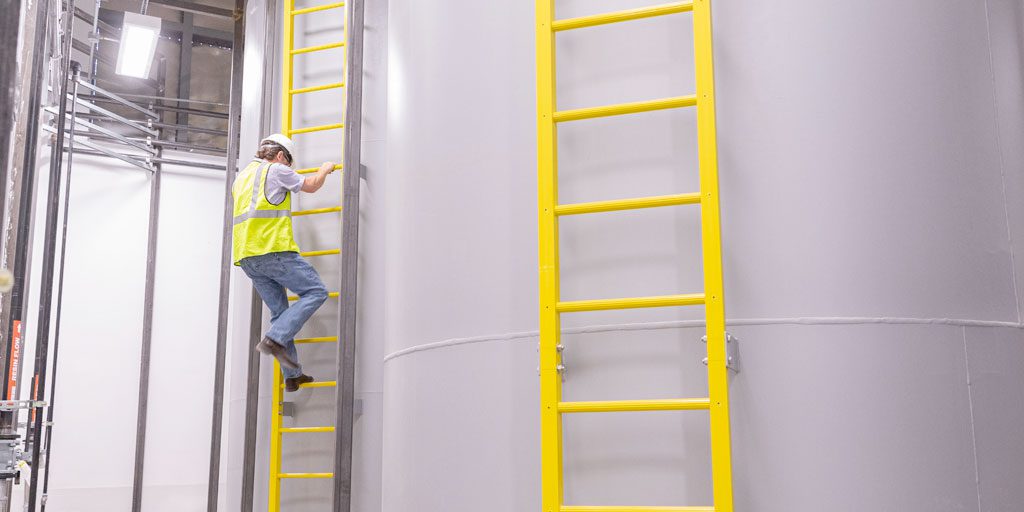
Is Your Vertical Access Built for Frequency?
Ladders are everywhere in industrial facilities. But not all ladders are built for the way they’re actually used.
If your team is climbing every day, your access systems should be:
- Engineered for repeated use
- Equipped with proper safety components
- Aligned with evolving OSHA requirements
- Designed to reduce risk — not introduce it
When ladder access is part of your daily operation, there’s no room for inconsistency. The right system doesn’t just meet code — it supports your people, your workflow and your uptime. If your current setup wasn’t designed for how your facility actually operates, it’s worth a closer look. Because safer access isn’t just about compliance — it’s about keeping work moving without interruption.
Take a Closer Look at Your Ladder Safety
Not sure if your facility is truly up to code — or built for the way your team actually works?
OSCO Safety offers on-site assessments to evaluate your current access systems, identify potential risks and recommend practical solutions tailored to your operation.
You’ll get:
- A real-world evaluation of access points and workflows
- Insight into OSHA alignment and gaps
- Clear, actionable recommendations — not guesswork
Contact OSCO Safety, call 304-949-1381 or request a site visit to bring experienced safety insight directly to your facility.